Through the Faculty-Student Collaborative Research program, students gain hands-on
experience working alongside faculty mentors while contributing to projects that advance
knowledge, innovation and discovery across a wide range of disciplines.
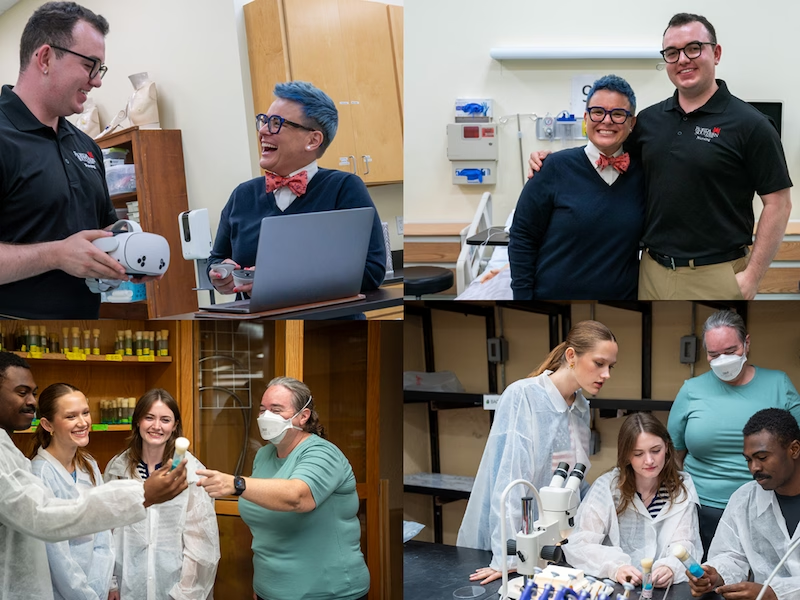
Dr. Jennie Lynn Florkey with Kevin Vondruska:
“Experiencing Care from the Other Side: Role-Reversal Virtual Reality Simulation to
Enhance Empathy Toward Hispanic Patients with Limited English Proficiency”
Funded by the Office of the Provost.
For Dr. Jennie Lynn Florkey, Assistant Professor of Nursing, improving patient care
begins with building empathy.
Dr. Florkey's research focuses on identifying and removing barriers to nursing student
learning. In this project, that work took the form of virtual reality, immersing nursing
students in the experience of a patient with limited English proficiency during an
emergency department visit. Throughout the simulation, every clinical interaction
is conducted in Spanish, allowing students to experience firsthand the communication
barriers many patients face.
Dr. Florkey developed the project with Kevin Vondruska, a rising senior nursing student
and honors scholar who is fluent in Spanish. The idea came out of Alicante, Spain,
where they traveled together in Summer 2025 alongside a study abroad trip to Spain.
When Dr. Florkey brought a student to the emergency department, she could not explain
the urgency in Spanish and was handed a form and directed to wait. A Spanish-speaking
colleague described the same symptoms, and the student was taken back immediately.
Vondruska saw the barrier from the other side, translating for the group when their
interpreter fell ill and later for a patient on a clinical rotation whose basic needs
were going unmet.
"In Spain, I saw what happens when a patient cannot explain what is wrong. Back home,
I saw what happens when a nurse cannot understand what a patient needs,” Vondruska
said. “I think even ten minutes in a patient’s shoes, struggling to be understood,
could change the way future nurses answer the next call light.”
This summer, Dr. Florkey and Vondruska have been filming clinical scenarios with actors
and developing a custom virtual reality application. The simulation follows a patient
seeking treatment for acute appendicitis and demonstrates how language barriers can
affect communication throughout the healthcare experience.
"This matters because patients with limited English proficiency face serious risks
in healthcare settings. Misunderstandings can lead to misdiagnosis, medication errors
and delayed treatment," Dr. Florkey said. "By putting nursing students in that position,
we hope to build the kind of empathy that shapes how they communicate and advocate
for patients throughout their careers."
This fall, more than 50 senior nursing students will participate in an IRB-approved
study measuring changes in empathy and attitudes before and after completing the simulation.
The project aims to prepare future nurses to communicate more effectively, advocate
for diverse patient populations, and deliver compassionate, patient-centered care.
Dr. Susan Banks with Ava Benedict, KatieGrace Cassidy and Kemar Samuel:
“Behavioral analysis of synaptic associated Parkinson’s Disease-linked proteins in
Drosophila melanogaster”
Funded by Hansen Science Scholars Fund and the Office of the Provost
Inside the laboratory of Dr. Susan Banks, Associate Professor of Biology, students
are investigating one of neuroscience’s enduring mysteries: the biological mechanisms
behind Parkinson’s disease.
Although several proteins have been linked to the disease, its underlying causes remain
largely unknown. Building on previous discoveries, Dr. Banks is examining whether
proteins associated with Parkinson’s disease interact with other proteins essential
to normal neuron function and how those interactions influence the health of nerve
cells.
“The goal of this research is to determine if those interactions have an impact on
neuron function,” Dr. Banks said. “Using the powerful genetics of the Drosophila melanogaster,
or fruit fly, system, students generate fruit flies that express the genes of interest
in a model of Parkinson’s disease and observe how that genetic background alters motor
behaviors in the flies.”
Working alongside students Ava Benedict, Katherine Grace Cassidy, and Kemar Samuel,
the research team has already developed new experimental models and generated data
that will guide future investigations while providing students with hands-on experience
in genetics, neuroscience and experimental design.