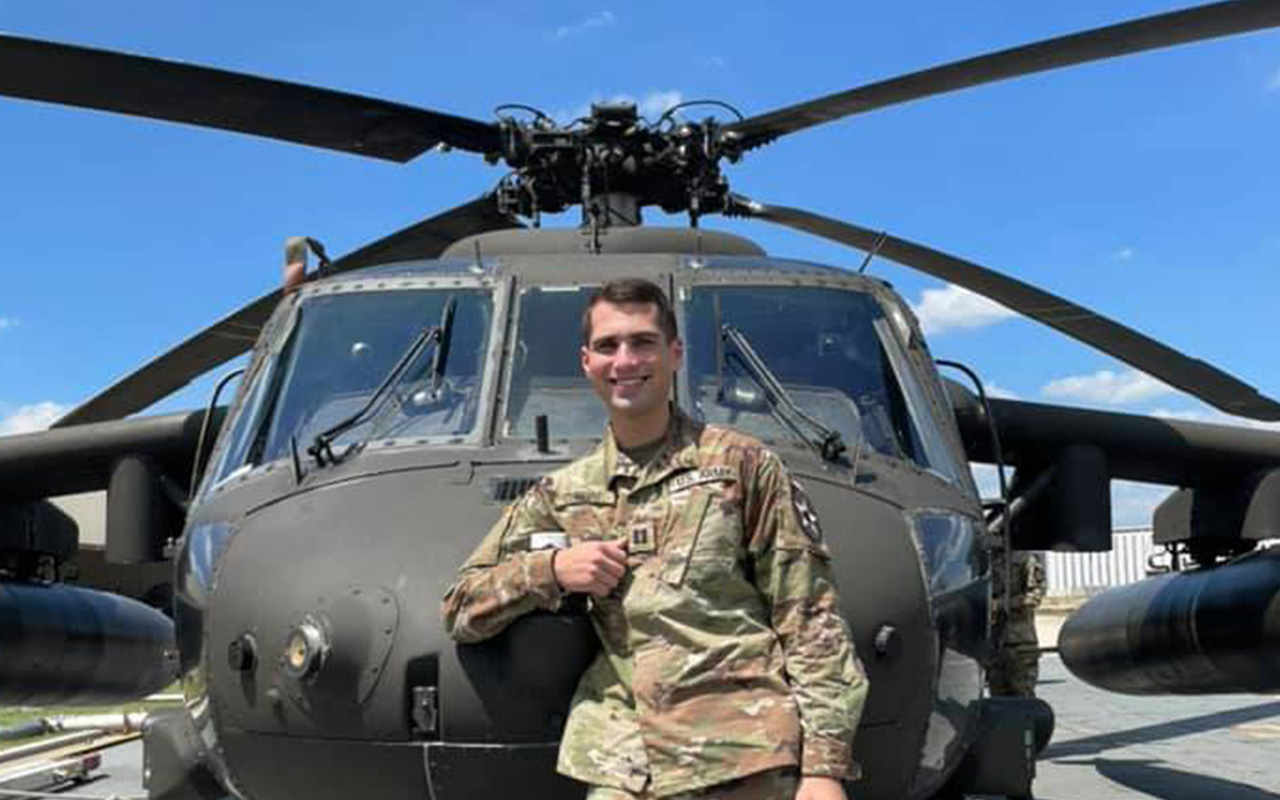
CPT Pedro Cuervo '17 poses in front of an Apache attack helicopter
When Pedro Cuervo ’17 set foot on the campus of Florida Southern College as a freshman,
he already knew he wanted to be in the military.His mother and father served, so the
Lakeland native had a good indication of what life would be like in the armed forces.
What he did not know was what he wanted to do in the military. That problem was solved
when he learned about the Judge Advocate General (JAG) Corps as a Moccasin Battalion
ROTC program member.“I already was committed to Army service, but the opportunity
to serve as an attorney was one I knew I couldn’t pass up,” said Cuervo, now a Captain
and a defense attorney at Joint Base Lewis-McChord outside of Tacoma, Wash. “It seemed
like such an exciting and diverse way to challenge myself. Looking back, I think I
was right.”Career Path
Cuervo earned his Bachelor of Science in political science from FSC in 2017.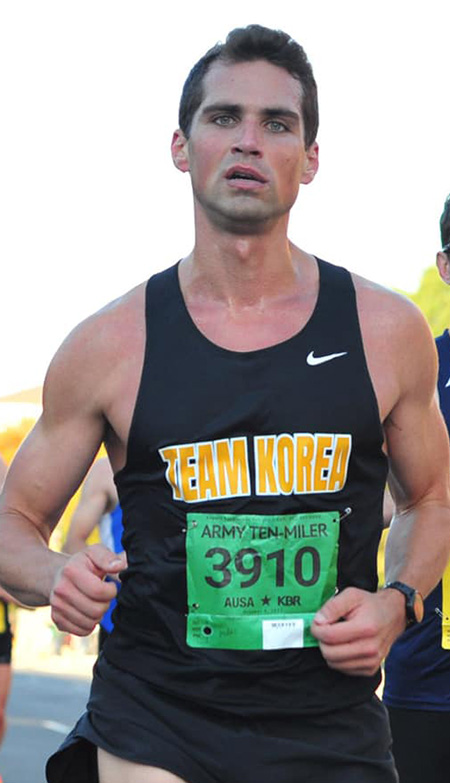
His determination and purpose were evident to Dr. Bruce Anderson, FSC’s pre-law advisor
and the Dr. Sarah D. and L. Kirk McKay Jr. Chair in American History, Government,
and Civics.“Pedro was always a relentless student, as serious about his immediate
study as he was about his future,” said Dr. Anderson. “He took the toughest route
to law school: via the military. He was not only granted a deferment for duty to go
to law school but was also accepted into the JAG program before he set foot in any
law classroom. The Army took his skills on faith, something they rarely do, but they
saw something in Pedro. We all did.”After Florida Southern, Cuervo graduated from
the Stetson University College of Law. Despite a slight delay due to the COVID-19
Pandemic, he passed his bar exam in October 2020. After a training exercise, Cuervo
was ready to deploy for service.The skills Cuervo learned at Florida Southern helped
guide him along the way.“FSC challenged me to think critically and be open-minded,”
he said. “As a political science major, one of the greatest skills I learned at FSC
was understanding how different schools of thought shape the people around us and
society as a whole. I’m very grateful that I had professors like Dr. (Bruce) Anderson
and Dr. (Kelly) McHugh who held me to a high standard and encouraged me to work and
think as hard as I could. I would not be very successful today without their guidance
and mentorship.”In the Army
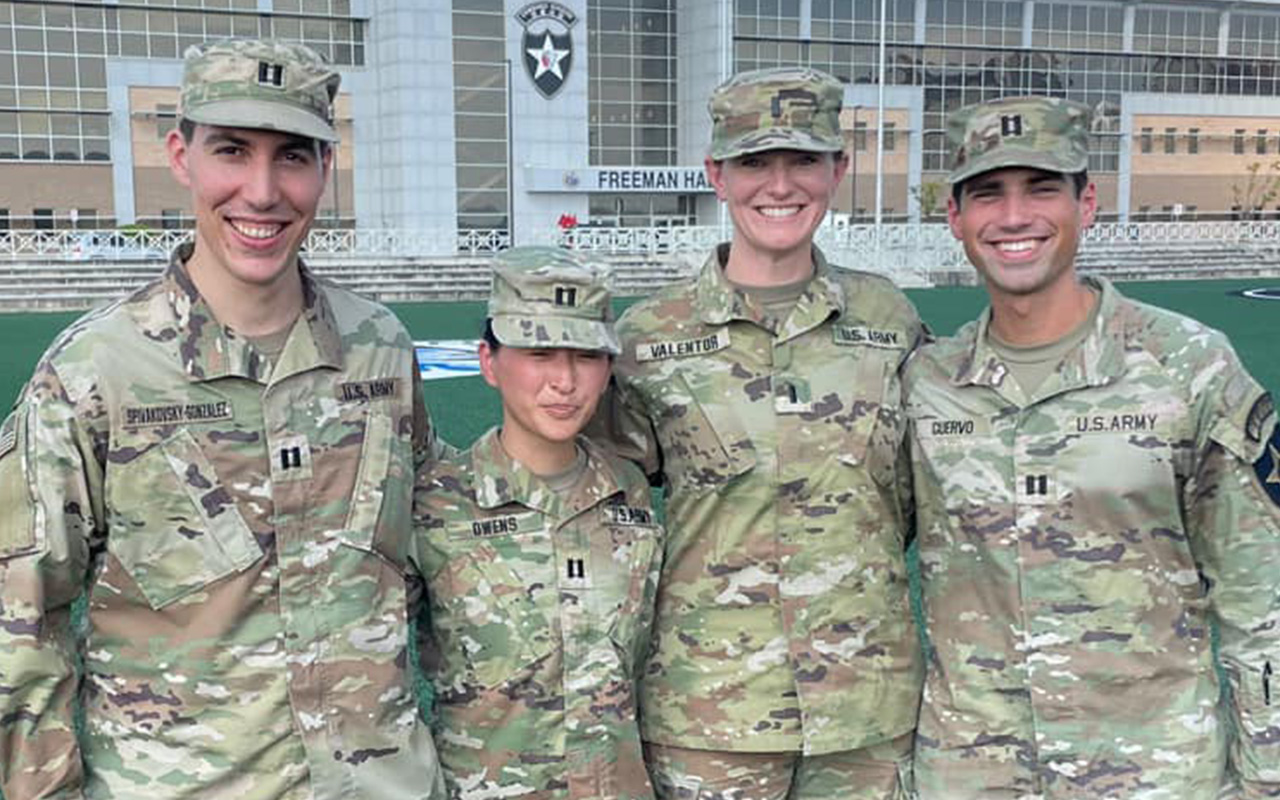
After training, Cuervo’s first stop was at Camp Humphreys, South Korea, with the 2nd
Infantry Division/Republic of Korea-U.S. Combined Division. Camp Humphreys is the
largest U.S. military installation in the world. It sits just 60 miles from the Demilitarized
Zone that divides North and South Korea.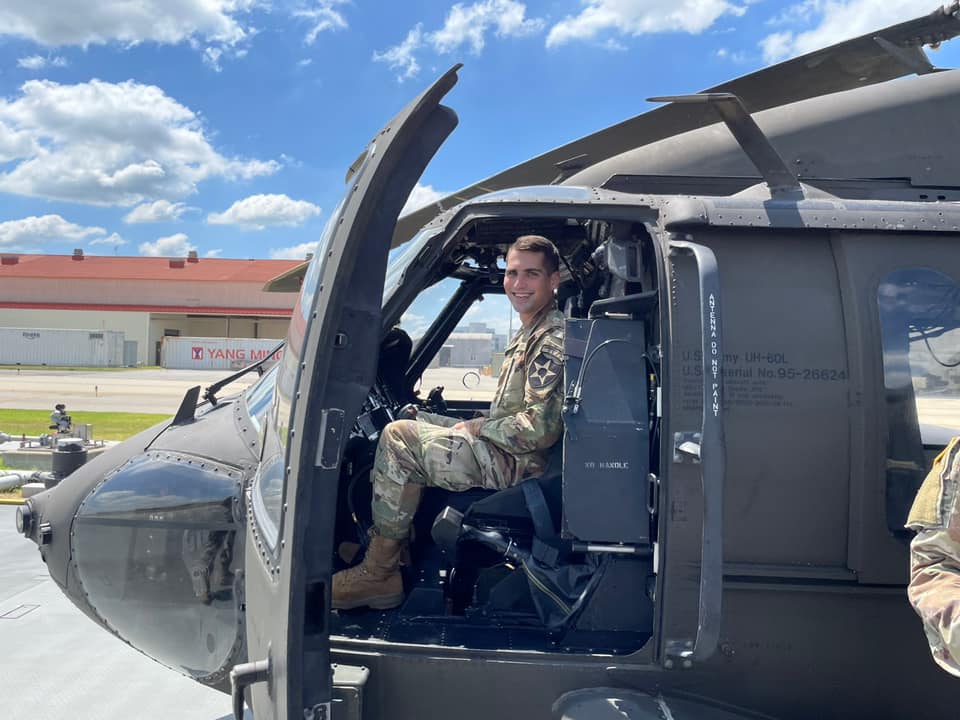 At Camp Humphreys, Capt. Cuervo served as the Division’s Chief of National Security
Law.Capt. Cuervo was the action officer for all national security law-related issues
serving 12,000 soldiers. He oversaw legal support for division exercises, was the
point of contact for international and operational law issues, and was the lead officer
for the status of forces agreement issues, including the trials of soldiers in Korean
court.Capt. Cuervo also coordinated legal support for international law and operational
issues.“The most important aspect of my job has been the welfare of the soldiers around
me and ensuring that their needs are taken care of,” he said. “The Division Office
of the Staff Judge Advocate, which is the legal nucleus that supports the division
for all legal matters, is a tight-knit group. I have always strived to be a positive
influence within the office and to make everyday fun while also completing the mission.
I love being a part of a team, and I’ve enjoyed having a role where I am relied upon
by the other members of the Division staff, and I can rely on them as well.”Capt.
Cuervo’s role will be a little different at Joint Base Lewis-McChord.
At Camp Humphreys, Capt. Cuervo served as the Division’s Chief of National Security
Law.Capt. Cuervo was the action officer for all national security law-related issues
serving 12,000 soldiers. He oversaw legal support for division exercises, was the
point of contact for international and operational law issues, and was the lead officer
for the status of forces agreement issues, including the trials of soldiers in Korean
court.Capt. Cuervo also coordinated legal support for international law and operational
issues.“The most important aspect of my job has been the welfare of the soldiers around
me and ensuring that their needs are taken care of,” he said. “The Division Office
of the Staff Judge Advocate, which is the legal nucleus that supports the division
for all legal matters, is a tight-knit group. I have always strived to be a positive
influence within the office and to make everyday fun while also completing the mission.
I love being a part of a team, and I’ve enjoyed having a role where I am relied upon
by the other members of the Division staff, and I can rely on them as well.”Capt.
Cuervo’s role will be a little different at Joint Base Lewis-McChord.
He has a new challenge as a member of the Trial Defense Services (TDS), but it is
one he feels more than capable of rising to.“Instead of looking out for the best interests
of an Army unit, I am representing individual soldiers who are charged with crimes
under the Uniform Code of Military Justice,” Pedro said. “My job will be to get the
best resolution I can for those soldiers.”